
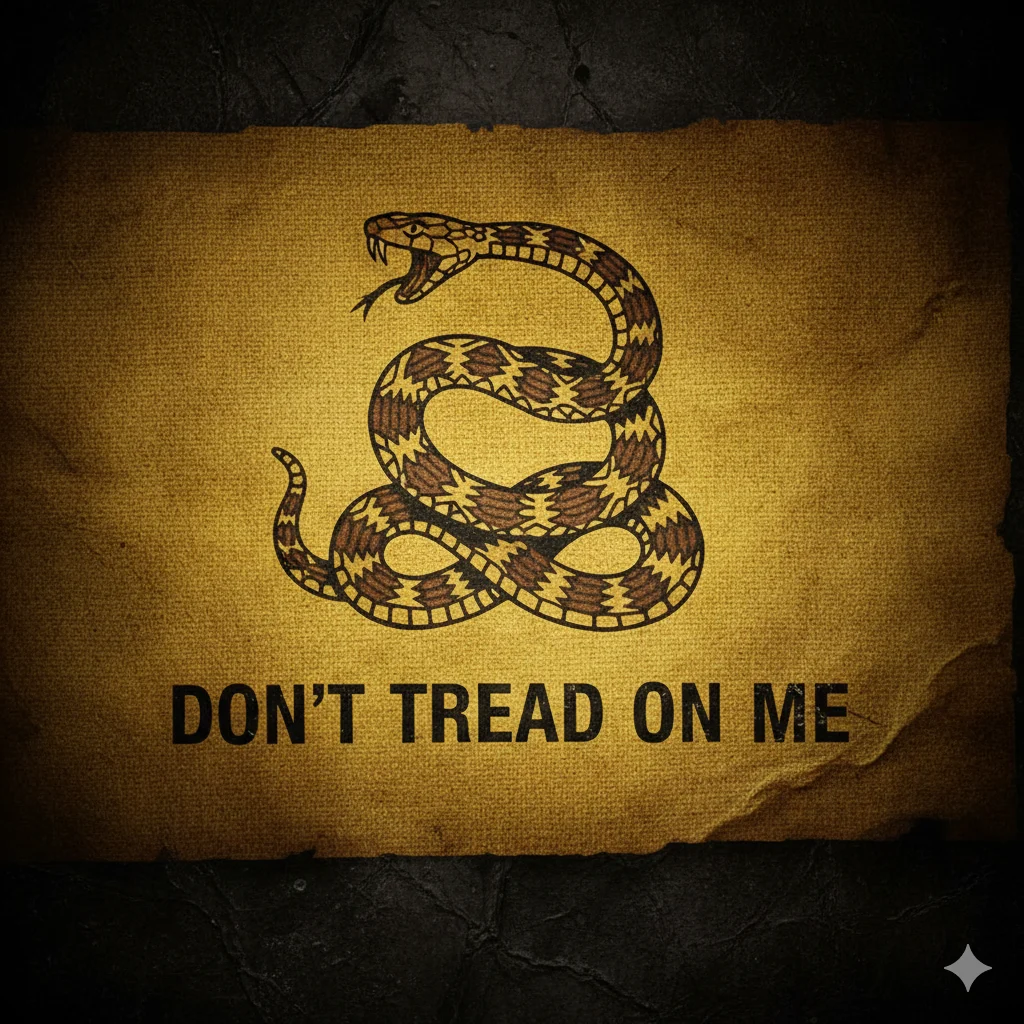
I’ll never forget the first time I saw a bright yellow flag with a coiled rattlesnake on a jacked-up truck. Beneath the snake, in bold letters, were the words: “DON’T TREAD ON ME.” My heart did a little flip. It looked aggressive, historic, and a little intimidating. Was it a warning? A statement of rebellion? I was confused but utterly fascinated. If you’ve ever scrolled past this phrase online or spotted it on a bumper sticker and wondered what it’s all about, you’re in the right place. Let’s unravel the story behind one of America’s most iconic slogans.
“Don’t Tread On Me” is a historic American slogan meaning “Do not oppress or threaten me.” It’s a powerful statement of defiance, individualism, and the right to self-defense, originating from the Gadsden Flag during the American Revolution.
🧠 What Does “Don’t Tread On Me” Mean?
At its core, “Don’t Tread On Me” is a warning. It’s a declaration that the person or group flying this symbol will not tolerate oppression, coercion, or threats to their liberty. The word “tread” here means to step on, crush, or oppress. So, the phrase is a metaphorical way of saying, “Do not step on me,” or more plainly, “Do not try to control me, or there will be consequences.”
The symbol is almost always paired with a coiled rattlesnake, ready to strike. This imagery is crucial. A rattlesnake is a creature that, according to the folklore of the time, never starts a fight but will always defend itself fiercely when provoked. It gives a warning rattle before it strikes, embodying the idea of a justified defense rather than unprovoked aggression.
In short: Don’t Tread On Me = A warning against oppression = “I will defend my liberty if provoked.”
📜 The Surprising History of the Gadsden Flag
You can’t understand “Don’t Tread On Me” without knowing about the Gadsden Flag. This iconic yellow flag was designed in 1775 during the early days of the American Revolution. It is named after Christopher Gadsden, a politician and general from South Carolina.
Gadsden presented the flag to the newly-appointed commander-in-chief of the Continental Navy, to be flown on its warships. The rattlesnake was already a potent symbol of the American colonies, appearing in publications like Benjamin Franklin’s Pennsylvania Gazette with the warning “Join, or Die.” The message to the British Crown was clear: “We are a united force. If you continue to tread on our rights and liberties, we will have no choice but to fight back.”
📱 Where Is “Don’t Tread On Me” Commonly Used Today?
While its roots are in the 18th century, “Don’t Tread On Me” is very much alive in the 21st. You’ll encounter it in various contexts, both offline and online.
- Political Rallies & Movements: 🗳️ It’s a common sight at libertarian, conservative, and Tea Party events, symbolizing a commitment to small government and individual freedoms.
- Social Media & Memes: 💻 The phrase and the snake emoji (🐍) are used in online debates about personal rights, gun ownership, and government overreach.
- Merchandise & Apparel: 👕 You’ll find it on T-shirts, hats, patches, and bumper stickers as a statement of personal identity and defiance.
- Texting & Messaging: 💬 While less common, it can be used shorthand to express a feeling of being pushed too far or to assert one’s independence in a conversation.
- Military & First Responders: ⭐ Some units and individuals use variations of the flag to connect with its historical, revolutionary spirit.
💬 Examples of “Don’t Tread On Me” in Modern Conversation
The phrase is versatile. Here’s how it might pop up in different dialogues today.
Example 1: In a Political Debate
A: I just don’t think the government should be able to mandate that.
B: Exactly. It’s a classic case of overreach. Don’t tread on me.
Example 2: On Social Media
Post: A picture of the Gadsden flag with the caption: “When they come for your rights… remember what this stands for. #DontTreadOnMe #Liberty”
Example 3: In a Text Argument
A: You have to come to this family event, it’s mandatory.
B: Sorry, but you can’t force me. Don’t tread on me, I’ll make my own decisions.
Example 4: As a Personal Mantra
A: I’m thinking of starting my own business and leaving this 9-to-5 grind.
B: Go for it! Live that ‘Don’t Tread On Me’ life.
Example 5: In a Discussion About Hobbies
A: Why do you spend so much on your home security system?
B: It’s my own little “don’t tread on me” policy. I believe in being prepared to defend what’s mine.
🕓 When to Use and When Not to Use “Don’t Tread On Me”
This is a powerful phrase with strong connotations. Using it correctly is key to being understood.
✅ When It’s Appropriate to Use
- At Political Events: When discussing principles of liberty and limited government.
- In Personal Assertions: When you need to firmly, but metaphorically, set a boundary against someone controlling.
- As Historical Reference: When teaching or discussing American Revolutionary history.
- In Online Forums: In dedicated communities where the phrase’s meaning is widely shared and understood.
❌ When to Avoid Using It
- In Formal Business Settings: It’s far too aggressive and politically charged for a professional email or meeting.
- During a Casual Compromise: Telling a friend “don’t tread on me” because they want to choose the movie is a massive overreaction.
- With an Unfamiliar Audience: Without context, it can be misinterpreted as hostility or associated with specific extremist groups that have co-opted the symbol.
- In Urgent or Serious Situations: If there is a real, immediate threat, use clear and direct language, not a historical metaphor.
Contextual Usage Table
| Context | Example Phrase | Why It Works or Doesn’t |
|---|---|---|
| Political Discussion | “My belief in the 2nd Amendment is my ‘don’t tread on me.'” | Directly connects to the phrase’s core meaning of self-defense. |
| Workplace Disagreement | “I understand your point, but I have to push back on this approach.” | Professional and clear, without the aggressive historical baggage. |
| Formal Email | “I must insist on maintaining the agreed-upon boundaries for this project.” | Polite, firm, and appropriate for a professional context. |
🔄 Similar Slogans and Symbols of Defiance
“Don’t Tread On Me” isn’t the only phrase that carries this spirit. Here are some other symbols and slogans centered on resistance and liberty.
| Slang/Symbol | Meaning | When to Use |
|---|---|---|
| “Come and Take It” | A defiant challenge, often associated with gun rights. | To express unwavering refusal to surrender something under threat. |
| “Molôn Labé” | Ancient Greek for “Come and take them,” a similar challenge. | Used for a more classical or dramatic emphasis of defiance. |
| “Live Free or Die” | A statement that liberty is the highest value, worth dying for. | As a personal motto emphasizing freedom above all else. |
| “You’ll get my [object] when you pry it from my cold, dead hands” | A modern, hyperbolic expression of absolute refusal to surrender something. | Used for dramatic, often humorous, effect in arguments. |
🐍 The Deeper Symbolism of the Rattlesnake
Why a snake? The colonists didn’t pick this animal at random. Benjamin Franklin, in 1775, penned a essay defending the rattlesnake as an appropriate symbol for America. He described its traits: it never surrenders, it gives a fair warning before attacking, and it is a creature perceived as new and unique to the “New World.” The coiled snake on the Gadsden flag is not attacking; it is in a defensive posture, a powerful visual of “leave me alone, and I will leave you alone.”
🏴 The Gadsden Flag in Modern Politics
In recent decades, the Gadsden Flag has been adopted most prominently by the libertarian and conservative movements in the U.S. It symbolizes a resistance to high taxes, gun control, and extensive government regulation. For these groups, the “treading” is done by an overreaching federal government. However, its usage is not monolithic, and many Americans who fly it do so as a broad statement of personal freedom rather than a strict party affiliation.
⚠️ Controversy and Misinterpretation
Like many potent symbols, the Gadsden Flag is not without controversy. In the 21st century, some groups with extremist views have used the flag alongside other symbols, leading some to associate it with racism or far-right extremism. This has sparked debate about whether the flag’s original, patriotic meaning has been corrupted. It’s important to recognize that for the vast majority of its users, it represents a general philosophy of liberty, but its perception can vary dramatically depending on the context and the viewer.
🆚 “Don’t Tread On Me” vs. Other Revolutionary Flags
The Gadsden Flag had cousins! The Continental Army and various militias used several flags with similar themes. The most famous is the “Join, or Die” flag, which depicted a snake cut into pieces, representing the fragmented colonies. Another was the “Appeal to Heaven” flag, used by George Washington’s navy. Understanding these other flags helps place the “Don’t Tread On Me” message within a broader communications strategy of the revolutionaries.
💭 The Philosophy Behind the Phrase
At its heart, “Don’t Tread On Me” is a physical representation of a social contract philosophy. It implies that individuals have inherent rights (like life and liberty) and that the only legitimate government is one that protects those rights. When a government becomes the threat to those rights, the people have not just the right, but the duty, to defend themselves. This philosophy is a bedrock principle of the American founding.
❓ FAQs About “Don’t Tread On Me”
Is the Gadsden Flag a racist symbol?
While the flag itself is not inherently racist, it has been displayed by some white supremacist groups, leading to this association for some people. However, its primary and historical meaning is centered on general liberty and defiance against tyranny, and it is still widely used by people of all backgrounds for that purpose.
Can anyone fly the Gadsden Flag?
Yes, it is not an official government flag and is protected under the First Amendment as free speech. Its use is open to anyone who identifies with its message of individual liberty and self-defense.
What’s the difference between “Don’t Tread On Me” and the Thin Blue Line flag?
The Gadsden Flag is typically a symbol of skepticism toward government authority. The “Thin Blue Line” flag is a symbol of support for law enforcement. While both can relate to themes of order and defense, their primary focus (individual vs. institutional authority) is often very different.
Is the phrase used in other countries?
While its origins are uniquely American, the concept of a defiant warning against oppression is universal. The phrase and symbol have been adopted by libertarian and freedom-loving groups around the world.
✍️ Conclusion
“Don’t Tread On Me” is far more than a relic in a museum or a cool design on a T-shirt. It is a living piece of American rhetoric, a powerful cocktail of history, philosophy, and warning. From the decks of revolutionary warships to the bumpers of modern-day trucks, it carries a timeless message: I am a free individual, and I will not be dominated. Understanding its history and nuanced meaning allows us to appreciate its power and to use it, or interpret it, with the depth and respect such a potent symbol deserves.

Rony Tobi is a passionate author and content creator, known for his insightful and motivational writing. With a focus on personal development, creativity, and practical wisdom, Rony aims to empower his readers to think critically and embrace life’s opportunities. His articles blend storytelling with actionable advice, helping audiences navigate challenges while fostering growth, self-awareness, and inspiration.