
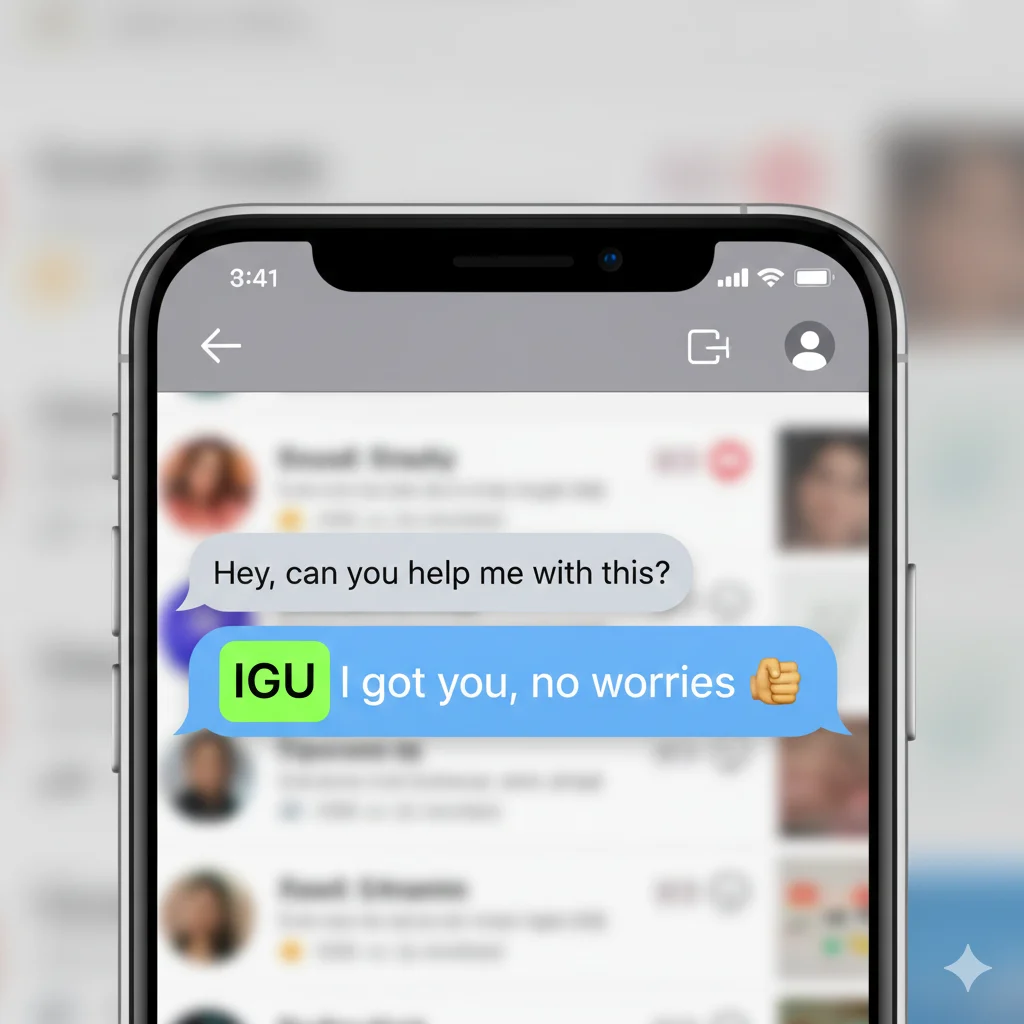
You’re scrolling through a group chat when your friend posts, “Running late, save me a seat?” Another pal quickly replies, “igu.” You pause, thumb hovering. Is it a typo? Some new acronym? A secret code you’re not cool enough to know? Don’t worry—we’ve all been there, squinting at a slang term that seems to have materialized out of the digital ether. The world of texting slang moves fast, and “IGU” is one of those effortlessly cool abbreviations that’s taken over DMs and comment sections. Let’s decode it together.
IGU means “I Got You.” It’s a friendly, casual, and reassuring way of saying “I understand,” “I’ll handle it,” or “I’ve got your back.”
🧠 What Does IGU Mean in Text?
At its core, IGU is simply an abbreviation for the phrase “I Got You.” It’s the shorthand, text-friendly version of offering assurance, help, or understanding. Think of it as the digital equivalent of a supportive nod or a quick pat on the back. It packs a lot of meaning—reassurance, agreement, solidarity, or acknowledgment—into just three letters.
The beauty of “IGU” lies in its versatility. It can mean:
- “I understand what you’re saying.”
- “I’ll take care of that for you.”
- “Don’t worry, I’m here for you.”
- “You’re covered; I’ve handled it.”
Example: “Don’t stress about the tickets. IGU.”
In short: IGU = I Got You = You’re supported/understood/covered.
📱 Where Is IGU Commonly Used?
The term IGU thrives in fast-paced, informal digital spaces where brevity is king. You’ll most commonly spot it in:
- 💬 Text Messaging: The primary home of IGU, used between friends and family.
- 📸 Snapchat & Instagram DMs: Perfect for quick, reassuring replies in direct messages.
- 🎮 Gaming Chats: Teammates use it to signal they have a situation under control (e.g., “Enemy on left! IGU”).
- 🎵 TikTok & Twitter Comments: Used to show support or agreement with a creator or poster.
- 👥 Group Chats: For coordinating plans or offering help without typing a full sentence.
Tone: IGU is firmly in the casual category. It’s friendly, relaxed, and social-media–friendly. It is not formal slang and should be avoided in professional or academic correspondence.
What Does the Number 5 Mean? Unpacking a Digital Love Code ❤️
💬 Examples of IGU in Conversation
Let’s see IGU in action with some realistic chat examples.
- As Reassurance:
A: “Ugh, I’m so nervous about this presentation.”
B: “igu, you’re gonna crush it. practiced with me, remember?” - Offering Help:
A: “I forgot my wallet at home omw to the cafe 😭”
B: “igu, i’ll cover your coffee. just get here.” - Showing Understanding:
A: “Sorry for venting about my day, it’s just a lot.”
B: “no need to apologize, igu. talk anytime.” - In Planning/Logistics:
A: “Who’s bringing the speakers to the party?”
B: “Already loaded in my car. igu.” - Gaming Context:
Player 1: “I need backup at the south entrance!”
Player 2: “heading there now, igu.” - As a Simple Agreement:
A: “Let’s meet at 7 instead? Traffic is wild.”
B: “igu, see you then.” - Confirming a Favor Was Done:
A: “Did you email that document to Mr. Davis?”
B: “Yep, sent it this morning. igu.”
🕓 When to Use and When Not to Use IGU
Knowing when to deploy “IGU” is key to using it effectively.
✅ WHEN TO USE IGU:
- In casual texts with friends, family, or peers.
- To quickly reassure someone.
- When confirming you’ve handled a small task.
- In online gaming for quick communication.
- To show solidarity or agreement in social media comments.
❌ WHEN NOT TO USE IGU:
- In formal emails to your boss, professor, or a client.
- During serious or emergency situations where clarity is critical.
- In official reports or academic papers.
- When communicating with someone who may not understand slang (e.g., older relatives).
- If the situation requires detailed explanation or emotional depth—use the full phrase “I got you” or more complete sentences.
| Context | Example Phrase | Why It Works / Doesn’t Work |
|---|---|---|
| Friend Chat | “Can you grab chips? IGU.” | Casual, efficient, and friendly. |
| Work Chat (with close teammate) | “I’ll handle the client follow-up. IGU.” | Can be okay if you have a very informal rapport. |
| Formal Email | “Please proceed at your convenience.” | “IGU” is too informal and unclear for this setting. |
| Comforting a Friend | “I’m here for you, I’ve got you.” | The full phrase is more heartfelt and emotionally present than the abbreviated “IGU.” |
🔄 Similar Slang Words or Alternatives
“IGU” isn’t alone in the world of quick reassurance. Here are some cousins in the slang family.
| Slang | Meaning | When to Use It |
|---|---|---|
| Bet | “Okay,” “Agreed,” “For sure.” | Confirming plans or showing agreement. |
| Gotchu | “I’ve got you” (same as IGU). | Even more casual, phonetic version of IGU. |
| FS / Fs | “For sure.” | Expressing certainty or definite agreement. |
| Np | “No problem.” | Responding to thanks or acknowledging a request. |
| Say Less | “Say no more, I understand.” | Signifying you’re on the same page immediately. |
| I’m on it | “I’m handling this.” | More explicit about taking immediate action. |
Is IGU Rude or Polite?
IGU is generally considered polite and friendly within its appropriate casual context. It’s a warm and efficient way to show someone you’re helping or listening. However, its perceived politeness depends entirely on the relationship and situation. For a friend, it’s supportive. In a formal complaint reply, it would seem dismissive and unprofessional. Always gauge the tone of the conversation.
🗣️ The Tone and Nuance of IGU
The tone of “IGU” can shift slightly based on the conversation. It’s most often supportive and solidary. It can also be confident and capable (e.g., “I’ll do that task, IGU”). It is rarely, if ever, flirtatious on its own, though it could be part of a flirty exchange if the existing context is already romantic. Its primary vibe is chill reliability.
📚 The Evolution of “I Got You” to IGU
The phrase “I got you” has long been a part of spoken English, offering assurance. The leap to “IGU” is a classic example of digital linguistics evolution. In the early 2000s, with the rise of SMS character limits and T9 texting, abbreviations like this boomed. “IGU” followed the same path as BRB (Be Right Back) or LOL (Laugh Out Loud)—born from the need for speed and efficiency in digital communication, then cemented into the culture by social media and gaming.
🌍 IGU Across Different Platforms
While the meaning stays the same, IGU’s usage frequency can vary by platform:
- Texting/SMS: High use. The origin point.
- Discord/Game Chats: Very high use. Essential for quick team coordination.
- Instagram/TikTok Comments: Common. Used as supportive shorthand (“Love this! IGU!”).
- Twitter: Moderate. Fits the fast-paced, conversational style.
- Professional Apps (Slack, Email): Low use. Generally too informal unless the workplace culture is very relaxed.
⚠️ Common Misconceptions About IGU
Let’s clear up some confusion:
- Misconception 1: It stands for “I Give Up.” (Incorrect in modern slang).
- Misconception 2: It’s always flirty. (It’s not inherently flirty; context defines that).
- Misconception 3: It’s only used by young people. (While popular with Gen Z and Millennials, its use is spreading across casual internet users of all ages).
- Misconception 4: It’s rude because it’s short. (In its proper context, it’s considered efficiently friendly, not rude).
🎯 How to Start Using IGU Naturally
Want to add “IGU” to your own digital vocabulary? Start small:
- Next time a friend asks for a small favor over text, reply with “Sure, igu.“
- In a group chat when someone voices a concern, chip in with “igu, don’t worry.“
- Pay attention to how others use it in your social circles. The best way to learn slang is through immersion and imitation in appropriate contexts.
❓FAQs About IGU
Q1: What does IGU stand for?
A: It stands for “I Got You.”
Q2: Is IGU polite to use?
A: Yes, in casual settings with friends, family, or peers. Avoid it in formal situations.
Q3: Can IGU be used in a flirty way?
A: By itself, it’s not inherently flirty. However, it can be part of a flirty conversation. For example, “Don’t worry about finding a date, IGU 😉” adds a suggestive layer.
Q4: What’s the difference between IGU and “Gotchu”?
A: They mean the exact same thing. “Gotchu” is just a more phonetic, even more casual spelling of the same assurance.
Q5: How do I respond to someone who says IGU?
A: A simple “Thanks,” “Appreciate it,” “You’re the best,” or even just a 👍 or ❤️ emoji is a perfect response.
✍️ Conclusion
So, the next time you see “IGU” pop up in your messages, you won’t miss a beat. You’ll know it’s a quick, cool, and caring way for someone to say, “I’m with you,” “I understand,” or “Consider it done.” It’s a tiny acronym that carries a significant weight of reassurance in our fast-paced digital conversations. From smoothing out plans to offering a bit of emotional backup, IGU is a versatile tool in the modern texter’s kit. Now that you’re in the know, you can confidently reply or even send an IGU yourself—just remember to keep it casual, keep it friendly, and save the formal prose for the email inbox.

Rony Tobi is a passionate author and content creator, known for his insightful and motivational writing. With a focus on personal development, creativity, and practical wisdom, Rony aims to empower his readers to think critically and embrace life’s opportunities. His articles blend storytelling with actionable advice, helping audiences navigate challenges while fostering growth, self-awareness, and inspiration.