
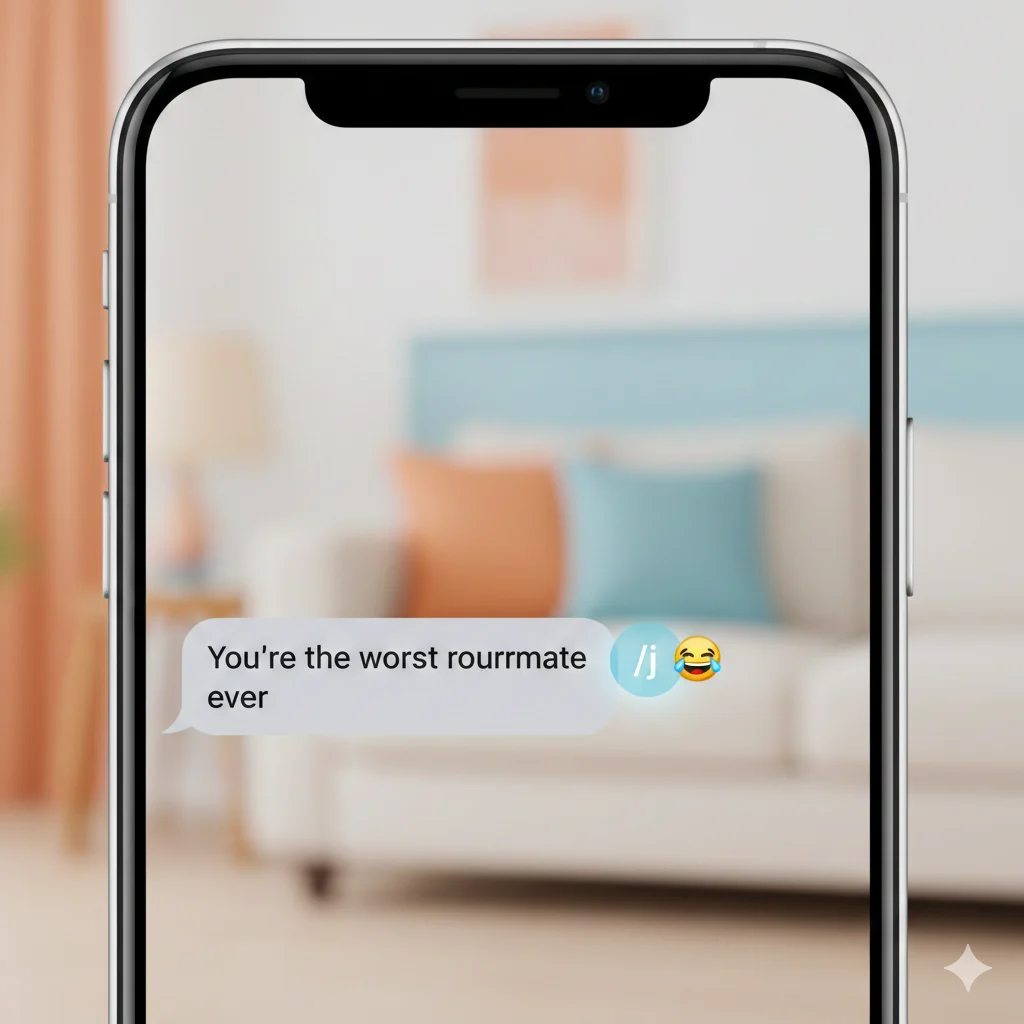
/j stands for “joking” or “just joking.” It’s a tone indicator used in text to clarify that a statement is meant to be humorous or not taken seriously.
Ever been scrolling through a Twitter thread or a Discord chat, seen someone end a wild statement with a cryptic “/j,” and felt a tiny pang of confusion? I remember the first time I saw it. Someone had written, “I’m deleting the internet, brb. /j” My brain stuttered. Was that a secret code? A typo? A new kind of emoji? In our fast-paced digital world, where sarcasm can fall flat and jokes can misfire, a little clarity goes a long way. That’s exactly where “/j” comes in—it’s a linguistic life raft in the sea of ambiguous text.
🧠 What Does /j Mean in Text?
In the simplest terms, /j is an abbreviation for “joking.” It belongs to a family of symbols known as tone indicators or tone tags. These are short codes, usually preceded by a forward slash (/), that people add to the end of their written sentences to explicitly state their emotional or rhetorical intent.
Why is this necessary? Text communication strips away vocal tone, facial expressions, and body language—the very things that tell us when someone is kidding. A sentence like “Wow, you’re a genius” could be sincere praise or biting sarcasm. Adding /j removes the guesswork: “Wow, you’re a genius /j” clearly signals the statement is a joke.
In short: /j = Joking = “I am not being serious; this is meant humorously.”
📱 Where Is /j Commonly Used?
The /j tone indicator thrives in communities where clear communication is valued and misunderstandings are common. You’ll most frequently spot it in:
- Social Media Platforms: Especially Twitter, Tumblr, and TikTok, where discussions can be nuanced and users are proactive about accessibility and clarity.
- Messaging & Group Chats: On Discord, Slack (in casual channels), and Instagram DMs, where friend groups use it to keep the vibe light.
- Online Forums & Fandom Spaces: Places like Reddit or fan-centric forums where debates are frequent, and marking jokes helps maintain a friendly atmosphere.
- Gaming Chats: In text chat during multiplayer games (like Minecraft or Valorant), where quick, playful trash talk is common.
Tone & Formality: /j is inherently casual and informal. It’s a tool for friendly, social, and community-oriented digital spaces. You would never use it in formal emails, academic papers, or professional reports.
💬 Examples of /j in Conversation
Let’s see how /j works in real, messy, authentic text exchanges.
Example 1: Playful Exaggeration
A: I just ate an entire large pizza by myself. I am a force of nature.
B: A force of gluttony, maybe? /j
A: The most powerful force of all 😂
Example 2: Clarifying Sarcasm
A: Ugh, my phone died right before I could save the document.
B: Wow, fantastic timing. You’re so organized. /j
A: I know, my skills amaze even me /j
Example 3: In a Group Chat Plan
A: Okay, meet at 7 PM sharp. If you’re late, we’re leaving without you.
B: So harsh! Your tyranny knows no bounds. /j
A: I learned from the best (you). /j
Example 4: Softening a Playful Jab
A: sends a meme that’s painfully unfunny
B: Did your dad make this meme? /j
A: LMAO rude! But… maybe.
Example 5: On Social Media (Tweet)
Tweet: “Waking up before noon on a Saturday should be illegal. I’m writing to my representative. /j”
🕓 When to Use and When Not to Use /j
Navigating when to tag your jokes is a key part of digital etiquette. Here’s a quick guide:
✅ When to Use /j
- When your joke is dry or sarcastic.
- When you’re teasing a friend playfully.
- In online communities where tone indicators are the norm.
- When communicating with neurodivergent folks who may appreciate explicit tone clarification.
- Whenever you’re worried your text could be read in the wrong, potentially hurtful way.
❌ When NOT to Use /j
- In formal writing (emails to your boss, essays, official documents).
- When the joke is extremely obvious (e.g., “I just tripped over air, I’m an Olympic athlete /j” – the humor is already clear).
- In urgent or serious conversations where clarity of fact, not tone, is the priority.
- As a cover for actually mean comments (using “/j” after an insult doesn’t make it okay).
Context Comparison Table
| Context | Example Phrase | Why It Works (or Doesn’t) |
|---|---|---|
| Friend Chat | “Your music taste is a crime. /j” | Casual, playful, and prevents the tease from being taken personally. |
| Online Debate | “That’s certainly a unique interpretation of the film. /j” | Softens the disagreement and frames it as a lighthearted observation. |
| Formal Email | “Please review the attached report at your earliest convenience. /j” | DO NOT DO THIS. It’s unprofessional and confusing in a formal setting. |
🔄 Similar Slang Words or Alternatives
/j is part of a whole toolkit for digital tone. Here are other common tone indicators and how they differ.
| Slang | Meaning | When to Use It |
|---|---|---|
| /s | Sarcastic / Serious | For obvious sarcasm. More edged than /j. (e.g., “Oh, I love Monday mornings. /s”) |
| /srs | Serious | To stress you are not joking at all. The direct opposite of /j. |
| /lh | Light-hearted | For comments that are playful and without heavy emotion. Similar to /j but less joke-specific. |
| /hj | Half-joking | For statements that blend truth and humor—”I’m kidding, but not really.” |
| /gen | Genuine | To show you are asking or stating something earnestly. |
| /pos | Positive | To convey a positive, wholesome connotation. |
🎯 The Origin and Purpose of Tone Indicators
Tone indicators like /j didn’t just appear randomly. They evolved organically, primarily within neurodivergent online communities (like autistic and ADHD spaces), where interpreting tone can be a consistent challenge. These communities pioneered their use to make digital socialization more accessible and less anxiety-inducing. Their adoption has since spread into the mainstream as a simple, effective form of digital empathy. Using /j isn’t just about clarifying your own joke; it’s about being considerate of your reader’s experience.
🤔 Common Misconceptions About /j
Let’s clear up a few things:
- It’s not “coddling” or “making communication lazy.” It’s precision tooling for a medium (text) that is inherently ambiguous.
- It’s not only for young people. People of all ages in digital spaces use and appreciate them.
- It doesn’t ruin the joke. For people who might miss the humor, it creates the joke. For others, it simply acts as a nudge and wink.
✍️ How to Use /j Correctly: A Mini-Style Guide
- Placement: Put it at the very end of the sentence it applies to. Example: “That plan is bulletproof… /j”
- Spacing: Typically, no space before the slash. Example: “hilarious /j” not “hilarious / j”.
- Capitalization: The tag itself is almost always lowercase (
/j, not/J). - Scope: It applies only to the sentence immediately before it. If you’re making multiple joking statements, you may need to tag each one.
❓ FAQs About /j
What does /j mean on TikTok?
It means the same thing: “joking.” On TikTok, you’ll see it in video captions or comments to indicate the content or statement is humorous and not to be taken literally.
Is /j the same as LOL or 😂?
Similar in intent, but more explicit. “LOL” can sometimes be used awkwardly or insincerely. The /j tone indicator is a more direct, unambiguous label for the sentence’s intent.
Can using /j be seen as condescending?
It can be, if used to explain a joke that was already very obvious to your audience. It’s best used for potentially ambiguous humor or in communities where it’s standard practice.
Are there other tone indicators like /j?
Yes, many! As shown in the table above, there’s a whole spectrum including /s (sarcastic), /gen (genuine), /lh (light-hearted), and /nm (not mad).
Do I have to use tone indicators?
No one is forced to, but using them is widely considered a kind and accessible practice, especially in diverse online spaces. It’s a small effort that prevents big misunderstandings.
💭 Conclusion
In the end, /j is more than just internet slang. It’s a sign of our collective effort to be better understood in a world of pure text. It represents a move toward more mindful, empathetic, and accessible digital communication. So, the next time you’re about to send a teasing message or a sarcastic quip into the void, consider tossing a /j on the end. It’s a tiny mark that says, “Hey, we’re playing on the same team here.” And who knows? You might just save a friendship, or at the very least, get the laugh you were aiming for. Now go forth and joke—clearly! /gen /lh

Mariah Cannon is an accomplished author and content creator, passionate about storytelling and delivering impactful messages. Through her writing, she explores themes of personal development, creativity, and the power of perspective. Her work is designed to motivate, inspire, and provide readers with practical insights for navigating life’s challenges while embracing growth and self-expression.