
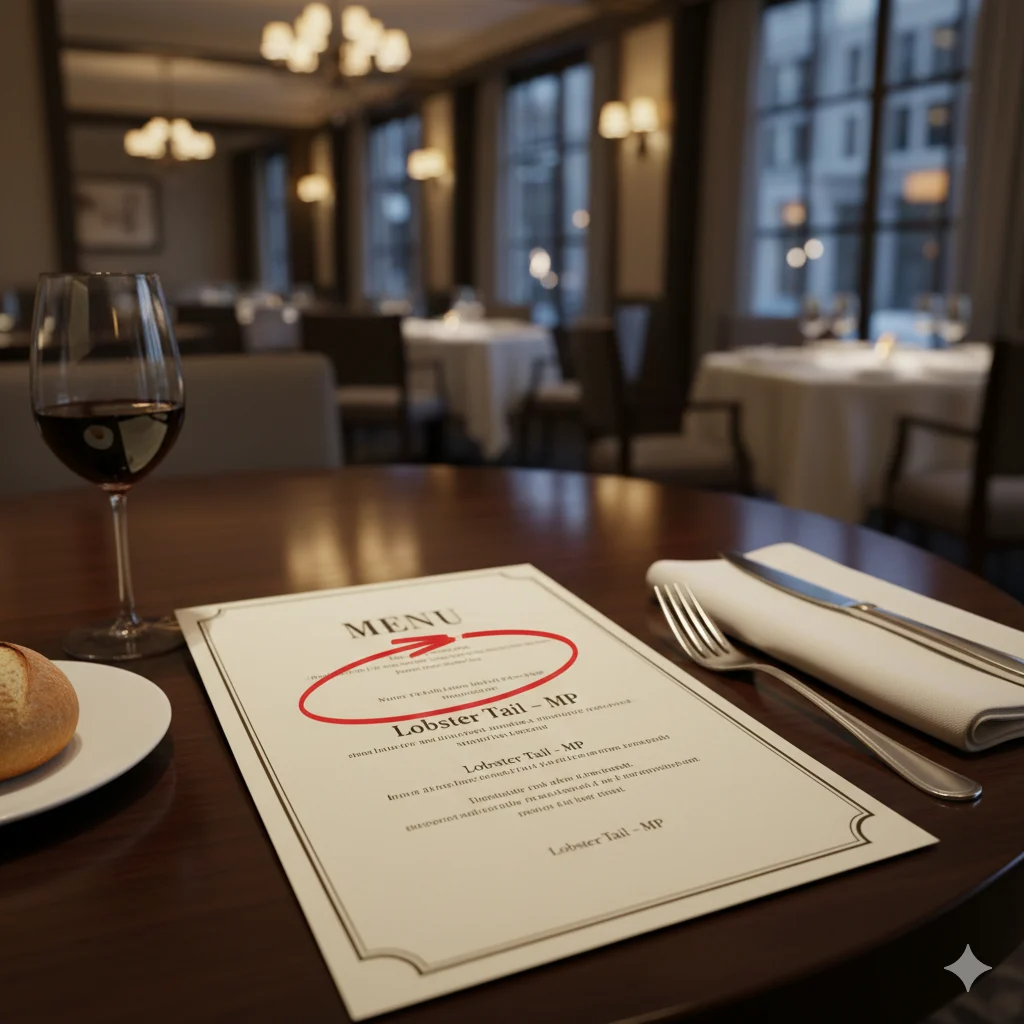
You’re sitting in a nice restaurant, celebrating a special occasion. The candlelight flickers as you scan the menu, dreaming of a perfect surf-and-turf. You see “Filet Mignon – $42” and nod. Then, your eyes drift down to the seafood section: “Fresh Atlantic Lobster – MP.” You pause. MP? Is that a cut of meat? A cooking style? Your mind races – is it an acronym for something fancy you should know? You feel a tiny pang of anxiety, not wanting to look uninformed in front of your date or guests. If this scene feels familiar, you’re not alone. “MP” is one of the most common yet confusing abbreviations on upscale menus. Let’s demystify it, so you can order with confidence.
MP on a menu means “Market Price.” It’s a formal and practical way for a restaurant to indicate that the cost of a specific dish (usually seafood or seasonal specialties) fluctuates daily based on market costs, and your server will tell you the current price.
🧠 What Does MP Mean on a Menu?
Let’s cut straight to the point. MP stands for “Market Price.” It’s not a secret chef’s code or a fancy French term. It’s a straightforward, albeit sometimes daunting, piece of restaurant shorthand.
When a menu item is listed as “MP” or “Market Price,” it means the cost of that dish is not fixed. Instead, it varies based on the current wholesale cost of the primary ingredient. This is almost exclusively used for items where the price can swing dramatically due to factors like seasonality, availability, weather, and catch size. The most common culprits are lobster, crab, certain fish like Dover sole or wild salmon, truffles, and sometimes premium steaks like Japanese Wagyu.
The restaurant isn’t trying to trick you. They’re protecting themselves from listing a price on a printed menu that might become financially unsustainable overnight if the market spikes. Imagine printing 500 menus advertising lobster for $50, only for the wholesale price to double the next day due to a storm preventing fishing boats from going out.
In short: MP = Market Price = “The cost changes, so ask your server for today’s rate.”
📱 Where Is MP Commonly Used?
You won’t find “MP” at your local diner or fast-food chain. Its use is specific to certain dining environments:
- 🍽️ Upscale Casual & Fine Dining Restaurants: This is the primary home of “MP.” Think white-tablecloth establishments, steakhouses, and high-end seafood grills.
- 🐟 Seafood-Centric Establishments: From lobster shacks in Maine to chic oyster bars in the city, if seafood is the star, MP is likely on the menu.
- 📅 Seasonal & Farm-to-Table Menus: Restaurants that pride themselves on hyper-seasonal ingredients may use MP for items like morel mushrooms or heirloom tomatoes at their peak.
- ✈️ Hotel & Resort Restaurants: Especially in tourist areas, where premium ingredients might be imported.
- 📜 Printed Menus (vs. Digital): MP is more common on printed menus that can’t be updated daily. A restaurant with digital menus or chalkboard specials might just write the daily price.
Tone: It is formal and industry-standard, not casual slang. Using “MP” is a professional practice, not a trendy text abbreviation.
💬 How to Navigate MP on a Menu: A Simple Guide
Seeing MP doesn’t have to be a stressful moment. Here’s a quick, realistic guide to the interaction:
Scenario 1: The Proactive Diners
- You: (Pointing to the menu) “I’m interested in the lobster tail listed as Market Price. Could you let me know what that is this evening?”
- Server: “Absolutely. Tonight, the market price for the whole lobster is $68, and the lobster tail entrée is $52.”
Scenario 2: The Budget-Conscious Inquiry
- You: “The scallops sound wonderful. Could I ask what the market price is currently?”
- Server: “Of course. The seared sea scallops are $44 tonight.”
- You: “Perfect, thank you. I’ll go with those.”
Scenario 3: When the Price Isn’t Listed
- Server: “Are we ready to order?”
- You: “Almost! I was just curious—what’s the market price for the Alaskan king crab legs?”
- Server: (Checks or recites from memory) “Those are $72 per pound this evening.”
The key is to always ask. It’s an expected and completely normal question.
🕓 When to Use and When to Avoid Asking About MP
This isn’t about “using” MP yourself, but about how to handle it as a diner.
✅ When to Ask About Market Price:
- When you are genuinely interested in ordering the item.
- When budgeting for your meal. There’s no shame in knowing the cost.
- When the server presents specials verbally and mentions a price “varies” or is “based on market.” Ask for the day’s specific price.
- When splitting the bill and you want to ensure everyone is comfortable with potential higher-cost items.
❌ When Not to Ask (or Order):
- If you are on a very strict budget. If seeing a high number will ruin your meal, it’s okay to skip asking and choose a fixed-price item.
- In extremely formal settings where price is never discussed aloud. (This is increasingly rare, but if your host insists on ordering for the table, follow their lead).
- If you have no intention of ordering it and are just asking out of idle curiosity. It can put unnecessary pressure on the server during a busy service.
| Context | Example Phrase | Why It Works |
|---|---|---|
| At a Steakhouse | “Could you tell me the market price for the 16 oz. Australian Wagyu strip?” | Direct, polite, and shows you understand the system. |
| At a Business Dinner | (To server) “Please let us know the current price for the lobster before we decide.” | Professional and ensures all parties are informed. |
| On a Date | “The Dover sole sounds amazing. Do you know what the market price is tonight?” | Confident and casual, making it a non-issue. |
🔄 Similar Menu Abbreviations & Their Meanings
“MP” isn’t the only cryptic letter pairing you might encounter. Here’s a quick decoder ring for other common menu shorthand.
| Abbreviation | Meaning | When You’ll See It |
|---|---|---|
| SP | Seasonal Price or Special Price | Similar to MP, but often for hyper-seasonal produce or daily chef’s features. |
| CF or GF | Gluten-Free | Next to dishes that are prepared without gluten-containing ingredients. |
| V, VG | Vegetarian, Vegan | Denoting plant-based dishes. |
| **† or *** | Footnoted Item | Usually points to a disclaimer like “Consuming raw or undercooked meats may increase your risk of foodborne illness.” |
| A la Minute | (Prepared) To Order / At the Minute | Not an abbreviation, but means the dish is made from scratch when you order it, leading to a longer wait. |
| Du Jour | Of the Day | As in “Soup du Jour” – the soup that is made fresh that specific day. |
🎣 The Psychology & Strategy Behind Market Pricing
Why does MP persist in the digital age? There are practical and psychological reasons:
- Perceived Premium Value: An “MP” tag can make an item feel exclusive, fresh, and of-the-moment. It signals: “This is so fresh and high-quality, we can’t even pin a static price to it.”
- Operational Flexibility: It protects profit margins in volatile markets. A restaurant can adjust the price daily based on their invoice without reprinting menus.
- The Conversation Starter: It forces an interaction with the server. This allows them to highlight a premium item, describe it in detail, and potentially upsell (“For $XX, it comes with two sides and is absolutely worth it.”).
💰 Tips for Ordering MP Items Without Sticker Shock
- Ask First, Order Second: Always, always get the price first.
- Ask for Unit Clarification: Is the price “per pound” or “for the whole dish”? A “$60 lobster” could be a 1.25lb whole lobster or a single tail. Ask: “Is that price for the entrée, or per pound?”
- Consider the Whole Bill: An MP item might be $20 more than a fixed-price steak. If you were planning on a cocktail, appetizer, and dessert anyway, the final bill difference may be less dramatic than you think.
- It’s Okay to Say No: If the price is higher than you’re comfortable with, simply smile and say, “Thank you, I’ll go with the [fixed-price item] instead.” Servers see this constantly and will not judge you.
🆚 MP vs. “Chef’s Selection” or “Omakase”
While MP deals with price, other terms deal with choice:
- MP (Market Price): You know what you’re getting (lobster), but the price varies.
- Chef’s Selection / Tasting Menu: You know the price, but the courses vary based on what the chef deems best that day.
- Omakase: (Japanese for “I leave it up to you”). Both the price and the specific dishes may be variable, though often there are set price tiers. It’s the ultimate trust-fall with the chef.
🚩 Potential Red Flags with MP (Rare, But Good to Know)
While generally standard practice, be wary if:
- A server refuses to give a clear price or says “it depends on size” without a per-pound baseline.
- The final charged price is significantly higher than what was verbally quoted.
- Too many items (more than 2-3) are listed as MP on a non-seafood menu, which could indicate price gauging.
In these very rare cases, it’s perfectly appropriate to calmly clarify with a manager.
❓ FAQs About MP on a Menu
Q: Is it rude to ask the price of an MP item?
A: Not at all. It is an expected and necessary question. Servers are trained to know the price and quote it politely.
Q: Can I negotiate the market price?
A: No. The market price is set by the restaurant based on their costs. It is not a negotiable figure like at a flea market.
Q: Why don’t they just print the daily price?
A: For restaurants with physical menus, printing costs are high, and market prices can change faster than menus can be reprinted. Some places do use inserts or chalkboards for this very reason.
Q: Does a higher MP always mean better quality?
A: Not necessarily. A high price can reflect scarcity (e.g., a storm-limited catch) or high demand (e.g., holiday season), not just superior quality. Trust the restaurant’s overall reputation.
Q: Should I tip on the final bill that includes MP items?
A: Yes. Gratuity is calculated on the final total bill, including any market-priced items you ordered.
Conclusion
Deciphering “MP” on a menu is a simple key to unlocking a more confident and enjoyable dining experience. It’s not a trick, a test, or a status symbol—it’s just practical restaurant economics. The next time you see those two little letters, you’ll know exactly what to do: engage your server, get the current price, and make an informed decision. Whether you splurge on that majestic whole lobster or opt for a delicious fixed-price alternative, you’ll do so without a hint of confusion, ready to savor the meal and the moment. Now, go forth and dine well

Rony Tobi is a passionate author and content creator, known for his insightful and motivational writing. With a focus on personal development, creativity, and practical wisdom, Rony aims to empower his readers to think critically and embrace life’s opportunities. His articles blend storytelling with actionable advice, helping audiences navigate challenges while fostering growth, self-awareness, and inspiration.