
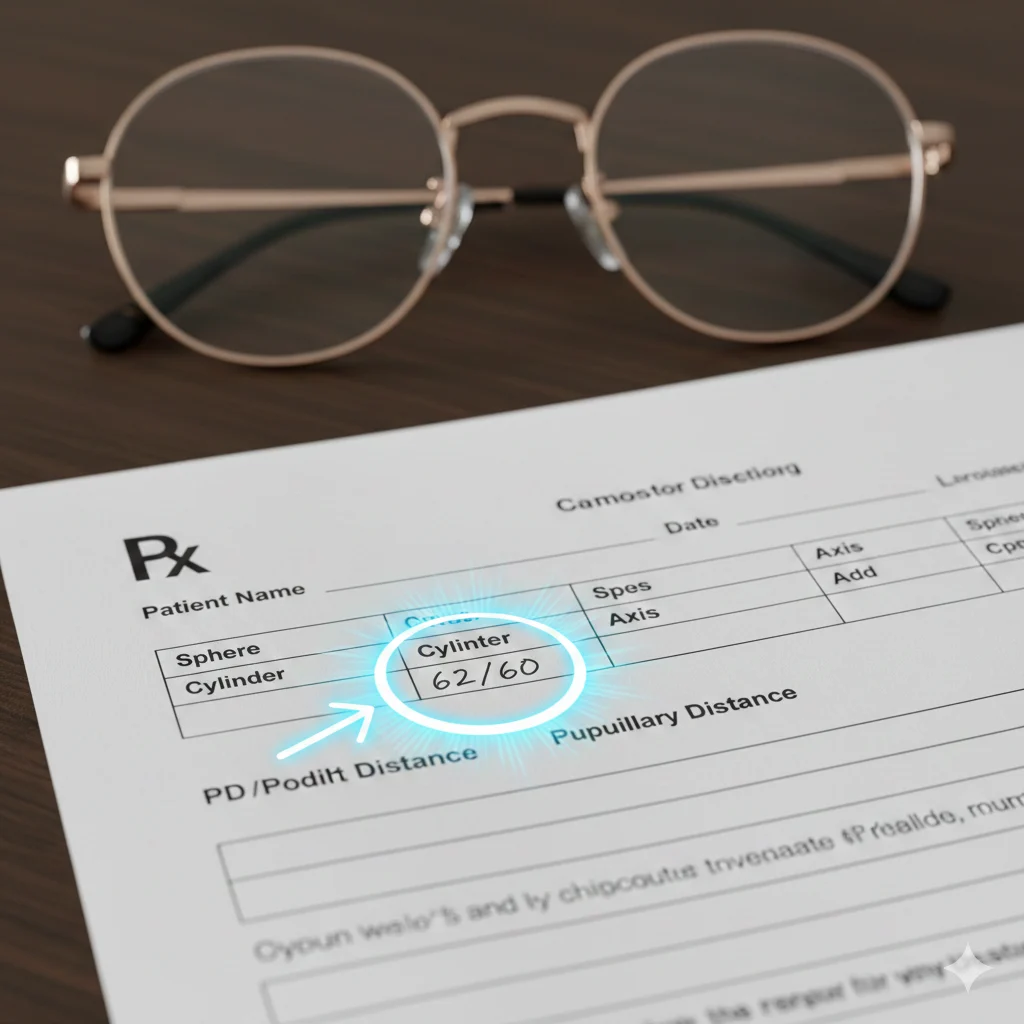
You’ve just had your eye exam, feeling pretty good about your 20/20… well, maybe 20/30 future. The optometrist hands you a slip of paper filled with mysterious numbers and abbreviations: OD, OS, SPH, CYL… and then there it is, often separate and sometimes even missing: PD. You stare at it, wondering, “What does PD mean for glasses, and why don’t I have a number here?” Is it a secret code? A medical diagnosis? Don’t worry, you’re not alone in the confusion. That little acronym is the final, crucial puzzle piece for turning your prescription into glasses that feel fantastic and work perfectly.
PD means “Pupillary Distance.” It’s the measurement, in millimeters, of the distance between the centers of your pupils. This number ensures the optical centers of your lenses are perfectly aligned with your eyes for clear, comfortable vision.
🧠 What Does PD Mean on an Eyeglass Prescription?
PD stands for Pupillary Distance. It’s a simple but vital measurement, recorded in millimeters (mm), that represents the distance from the center of one pupil to the center of the other when you’re looking straight ahead. Think of your lenses as having a sweet spot—the optical center where the prescription is most accurate. Your PD tells the optical lab exactly where to place that sweet spot in each lens of your frames.
If your PD is measured incorrectly and the lenses are ground off-center, you might experience eye strain, headaches, blurred vision, or a feeling that something is just “off.” It’s like wearing shoes made for someone else’s feet; even if they’re the right length, they’ll never fit correctly.
Example: Your prescription slip might list: PD: 63/61. This is a dual PD, showing your total distance (63mm) and the measurement from your nose to each pupil (e.g., 31.5mm for each eye, making 63 total).
In short: PD = Pupillary Distance = The ruler between your pupils for perfect lens alignment.
📏 How is PD Measured?
There are three primary ways to get your accurate PD measurement:
- By an Eye Care Professional: During your exam, they may use a specialized tool called a pupillometer or a simple PD ruler. This is the most accurate method.
- At Home with a Ruler: You can use a millimeter ruler and a mirror. Look straight ahead, close one eye, and align the ruler’s zero with the center of your open pupil. Note the measurement at the center of the other pupil. Repeat for accuracy.
- Digital Apps: Several reputable apps use your smartphone’s camera and a standard credit card (for scale) to estimate your PD. While convenient, they can be less accurate than professional methods.
👀 Why is PD So Important for Glasses?
Your PD isn’t just another number; it’s the cornerstone of comfortable eyewear. An incorrect PD leads to optical centers that are misaligned. This forces your eyes to work extra hard to find the clear “zone” through the lenses, leading to:
- Eye strain and fatigue
- Persistent headaches
- Blurred or distorted vision
- Dizziness or trouble focusing
- General discomfort, making you not want to wear your new glasses.
Getting it right means sharp vision, comfort for all-day wear, and getting the full benefit of your prescription.
📱 Where Will You Find the PD on a Prescription?
Typically, the PD is listed at the very bottom of your prescription, separate from the core sphere, cylinder, and axis numbers for each eye (OD and OS). It may be written as:
- Single PD: A single number (e.g., 62) representing the total distance.
- Dual PD: Two numbers (e.g., 63/61). The first is for distance vision, the second for reading/near vision (important for progressives/bifocals).
- Monocular PD: Two numbers (e.g., 31.5 | 31.5), showing the measurement from the center of your nose to each individual pupil. This is the most precise.
💬 Real Examples of PD on Prescriptions
Let’s decode what you might actually see on your paper:
Example 1 – Standard Single Vision:
text
OD (Right Eye): -2.00 SPH
OS (Left Eye): -2.25 SPH
PD: 64
Translation: You’re nearsighted. The optical center for both lenses should be placed 64mm apart in your chosen frames.
Example 2 – For Progressives/Bifocals:
text
OD: +1.50 -0.75 x 180
OS: +1.75 -0.50 x 175
PD: 62/59
Translation: You have astigmatism and need a “multifocal” lens. The lab will use 62mm for the distance portion and 59mm for the reading portion of the lenses.
🕓 When to Double-Check Your PD (And When Not to Worry)
✅ WHEN TO BE METICULOUS ABOUT YOUR PD:
- When ordering glasses online (this is the most common scenario where you need your own measurement).
- If you have a strong prescription (high myopia, hyperopia, or astigmatism).
- When getting progressive or bifocal lenses.
- If you experience discomfort with a new pair of glasses from a new provider.
- For children, whose PD changes as they grow.
❌ WHEN IT’S LESS CRITICAL (Professionals Handle It):
- When ordering directly from your optometrist or optician’s office—they almost always measure it as part of the fitting process.
- If you’re simply getting a copy of your existing, comfortable glasses (they can measure the PD directly from the old lenses).
🔍 PD vs. Other Prescription Abbreviations
Your prescription is a map. Here’s how PD relates to the other landmarks:
| Abbreviation | Stands For | What It Means | Why It’s Different from PD |
|---|---|---|---|
| OD / OS | Oculus Dexter / Oculus Sinister | Your right eye (OD) and left eye (OS) prescription. | PD is a binocular measurement for both eyes together. |
| SPH | Sphere | The main lens power to correct nearsightedness (-) or farsightedness (+). | SPH is a corrective power. PD is a physical measurement. |
| CYL & AXIS | Cylinder & Axis | Corrects astigmatism (irregular cornea shape). | These define how to correct vision. PD defines where to place that correction. |
🔄 Similar Fitting Measurements You Should Know
PD is the star, but it has a supporting cast for the perfect fit:
| Measurement | Meaning | When It’s Crucial |
|---|---|---|
| Segment Height (SH) | The vertical height from the bottom of the lens to where the reading segment begins. | Bifocals & Progressives. Ensures your reading zone is in the right spot. |
| Frame Width & Bridge | The total width of the frames and the distance across the bridge that rests on your nose. | All Glasses. For overall comfort and style—does the frame fit your face width? |
| Vertex Distance | The space between the back of your lens and the front of your cornea. | Very High Prescriptions. Affects the effective power of the lens. |
🎯How to Measure Your Own PD at Home
If you need to find your PD, here’s a reliable DIY method:
- Grab a millimeter ruler and stand in front of a mirror.
- Look straight ahead. Keep your head perfectly level.
- Close your right eye. Align the ruler’s “0” mark with the center of your left pupil.
- Without moving your head or the ruler, open your right eye and close your left.
- Read the millimeter line that now aligns with the center of your right pupil. That’s your single PD.
- Repeat 3-5 times to ensure a consistent reading.
(Note: For dual PD, you’d measure from the center of your nose to each pupil individually.)
🤔 Common Myths and Misconceptions About PD
Myth 1: “Everyone has the same PD.”
Fact: PD varies greatly! The average adult PD is between 54-74mm. It’s as unique as your fingerprint.
Myth 2: “If my old glasses are fine, I can just use that PD forever.”
Fact: For adults, PD is generally stable but can be measured slightly differently. Always get a fresh measurement for a new prescription or new frame style.
Myth 3: “A few millimeters off won’t make a difference.”
Fact: For people with strong prescriptions, even a 2mm error can cause significant discomfort and visual distortion.
❓FAQs About PD for Glasses
Q: Can I get my PD from my old glasses?
A: Yes! An optician can use a lensometer to find the optical centers of your old lenses and give you that PD measurement. This is a great option if your old glasses were comfortable.
Q: Why didn’t my doctor give me my PD?
A: In many places, the PD is considered part of the fitting process, not the prescription. It’s often taken by the optician when you choose frames. You are always entitled to this measurement—just ask!
Q: Is PD needed for contact lenses?
A: No. Contact lenses sit directly on your eye, so PD is not relevant. It’s only crucial for eyewear where lenses are fixed in a frame.
Q: What if my two eyes have different PDs (Monocular PD)?
A: That’s completely normal and actually allows for the most precise lens fitting, especially for wider frames or stronger prescriptions. It’s often written as two numbers (e.g., 32/31).
Conclusion
So, what does PD mean for glasses? It’s the simple yet non-negotiable key to visual comfort. Pupillary Distance ensures the engineering of your lenses aligns perfectly with the unique architecture of your face. Whether you’re ordering online or just want to be an informed patient, knowing your PD empowers you to get the clear, comfortable vision you’re paying for. Don’t overlook that little number—it’s the final step in seeing your best. Your next pair of glasses will thank you for it

Mariah Cannon is an accomplished author and content creator, passionate about storytelling and delivering impactful messages. Through her writing, she explores themes of personal development, creativity, and the power of perspective. Her work is designed to motivate, inspire, and provide readers with practical insights for navigating life’s challenges while embracing growth and self-expression.